If you've watched your organic traffic dip after Google rolled out AI Overviews, you're not alone. Traditional SEO-built on keyword density and backlink volume-no longer guarantees visibility. Today, search engines use AI to understand intent, synthesize answers, and often show zero-click results. That shift demands a new approach: AI SEO. In this guide, we break down how AI SEO differs from traditional SEO, why AI Overviews change the ranking landscape, and exactly how to evolve your strategy without starting from scratch.
Problem Background
AutoSEO Analysis: Strategic implementation results.
For years, SEO followed a predictable playbook: target high-volume keywords, build links, and optimize on-page elements. But Google's AI Overviews-intelligent answer boxes that appear at the top of search results-have disrupted that model. These overviews pull information from multiple sources, condense it, and often satisfy user queries without a single click. The result? Traditional click-through rates are falling, and websites that relied on snippet optimization or exact-match keywords are seeing traffic declines. The core problem isn't that SEO is dead-it's that the rules of relevance have changed. Google's AI now prioritizes content that demonstrates expertise, answers questions comprehensively, and fits into an interconnected topical structure. If your strategy still revolves around isolated keyword pages, you're fighting an AI-powered system with outdated tactics.
Core Concept
AI SEO isn't a buzzword-it's a fundamental shift from keyword-centric optimization to intent-centric, structured content. Traditional SEO focused on ranking for specific search terms by matching strings. AI SEO focuses on satisfying semantic queries through topical authority, entity clustering, and content that AI models can parse as trustworthy. Google's AI Overviews evaluate not just the relevance of a page, but its relationship to other pages within a site (internal linking), its source credibility, and how well it answers a user's underlying need. Where traditional SEO optimized for the blue link, AI SEO optimizes for the answer-and the context around it. This means building content clusters around core topics, using clear information architecture, and ensuring your site is seen as an authoritative hub rather than a collection of standalone posts.
Practical Approach
To pivot from traditional to AI SEO, start with a content audit. Identify pages that once drove traffic but now underperform. Group them into topic clusters and fill gaps with supporting content. Next, shift from single-keyword articles to comprehensive pillar pages that cover a topic in depth, then link to cluster posts that explore subtopics. For example, a pillar on 'AI SEO vs traditional SEO' should link to posts about AI Overview optimization, E-E-A-T signals, and structured data. Ensure each piece answers real user questions-use tools like People Also Ask and Google's own AI suggestions. Finally, build topical authority by consistently publishing within your niche and earning contextual internal links. Tools like AutoSEO.cloud's AI SEO Content Engine can automate this process, analyzing your existing content and generating cluster-optimized articles that align with how Google's AI evaluates relevance.
Common Mistakes
The biggest mistake is doubling down on old tactics: keyword stuffing, thin content, and building links without relevance. Another common error is ignoring the AI Overview impact-assuming zero-click results mean you can't win. In fact, being cited in an AI Overview can drive branded searches and indirect traffic. Also, many companies create content in silos without internal linking, missing the opportunity to show topical depth. Finally, neglecting E-E-A-T signals (like author bios, citations, and updated dates) can make your content invisible to AI models that prioritize trust. Avoid these missteps by embracing a holistic content system rather than a page-by-page approach.
How AutoSEO.cloud Helps
AutoSEO.cloud offers a complete SEO content system designed for the AI era. Our Automated SEO Article System uses AI to research, outline, and write articles that align with Google's AI Overview requirements. The AI SEO Content Engine analyzes your existing site, identifies topical gaps, and generates cluster content with built-in internal linking. With the SEO Plus plan, you get prioritization in our advanced automation queue plus dedicated support-perfect for agencies and SMBs ready to scale authority without manual churn. Whether you're pivoting from traditional SEO or building an AI-optimized site from scratch, AutoSEO.cloud provides the framework to earn visibility in both blue links and AI Overviews.
FAQ
Is traditional SEO dead with AI Overviews?
No, but it must evolve. Traditional SEO tactics like keyword optimization and backlinks still matter, but they are no longer sufficient. AI SEO adds layers of topical authority, content clustering, and intent-focused structure. Without adapting, you'll lose ground to sites that embrace the new paradigm.
How does Google AI Overview affect click-through rates?
AI Overviews often answer queries directly on the search page, reducing clicks to organic results. However, being cited in an overview can increase brand visibility and drive clicks to deeper pages. To survive, optimize for both featured citations and traditional clicks by providing comprehensive, structured content.
What is the difference between AI SEO and traditional SEO?
Traditional SEO focuses on ranking for specific keywords through on-page optimization and link building. AI SEO prioritizes semantic relevance, topical clusters, and content that answers user intent holistically. AI SEO also accounts for how Google's AI models assess expertise and authority across a site.
How can I optimize my content for AI Overviews?
Focus on creating thorough, authoritative content that directly answers user questions. Use clear headings, lists, and structured data. Build topical authority by interlinking related articles. Ensure your content is cited from credible sources and updated regularly to signal freshness and expertise.
What is the best way to pivot from traditional to AI SEO?
Start with a content audit to identify gaps and underperforming pages. Then reorganize your content into topic clusters with pillar pages. Use an AI-powered content system like AutoSEO.cloud to efficiently generate cluster articles that follow AI SEO best practices, including internal linking and E-E-A-T signals.
CTA
Ready to future-proof your SEO strategy? Try AutoSEO.cloud's SEO Plus plan-your fast track to AI-optimized content. Get priority automation, dedicated support, and a content system built for Google AI Overviews. Start your free trial today.
Internal Link Suggestions
- Link to [Why Google AI Overviews Reduce Clicks and How to Adapt Your SEO Strategy]
- Link to [Why AI Overviews Kill Clicks and How to Recover Your Traffic]
- Link to [SEO vs AEO vs GEO: How AI Is Redefining Search Optimization]
- Link to [What Is Google AI Overview? A Complete Guide for SEOs and Business Owners]
- Link to [How to Build an SEO Content System that Survives AI Overviews]
Image Prompts
- Hero image: A futuristic 3D scene with a large glowing AI Overview panel made of translucent glass floating above a classic search results page. The background is a clean white gradient with subtle royal blue and cyan light rays. A sleek magnifying glass icon with a digital AI core sits beside the panel. The composition emphasizes the shift from traditional blue links to an AI-powered answer box.
- Concept explanation image: A split-view 3D illustration: left side shows a traditional SEO pyramid (keywords, backlinks, etc.) in muted blue tones, right side shows a dynamic AI SEO network with interconnected nodes and a central AI brain. Both sides have glass-like elements. In the middle, a smooth transition arrow made of cyan light. The background is off-white with soft blue-purple gradients.
- Product workflow image: A 3D glass-like dashboard floating on a white background. Three interconnected modules: 'Analyze' (magnifying glass with AI sparkles), 'Optimize' (gear with chart lines), 'Adapt' (checkmark with AI Overview icon). Arrows in royal blue and cyan flow between them. Small floating elements like keywords and rankings fade into the background. Clean, no extra clutter, with AutoSEO.cloud logo subtly placed in bottom right.
Disclaimer
This article is for educational purposes. Results may vary based on your specific site, industry, and competition. Always test and adapt strategies to your own context.
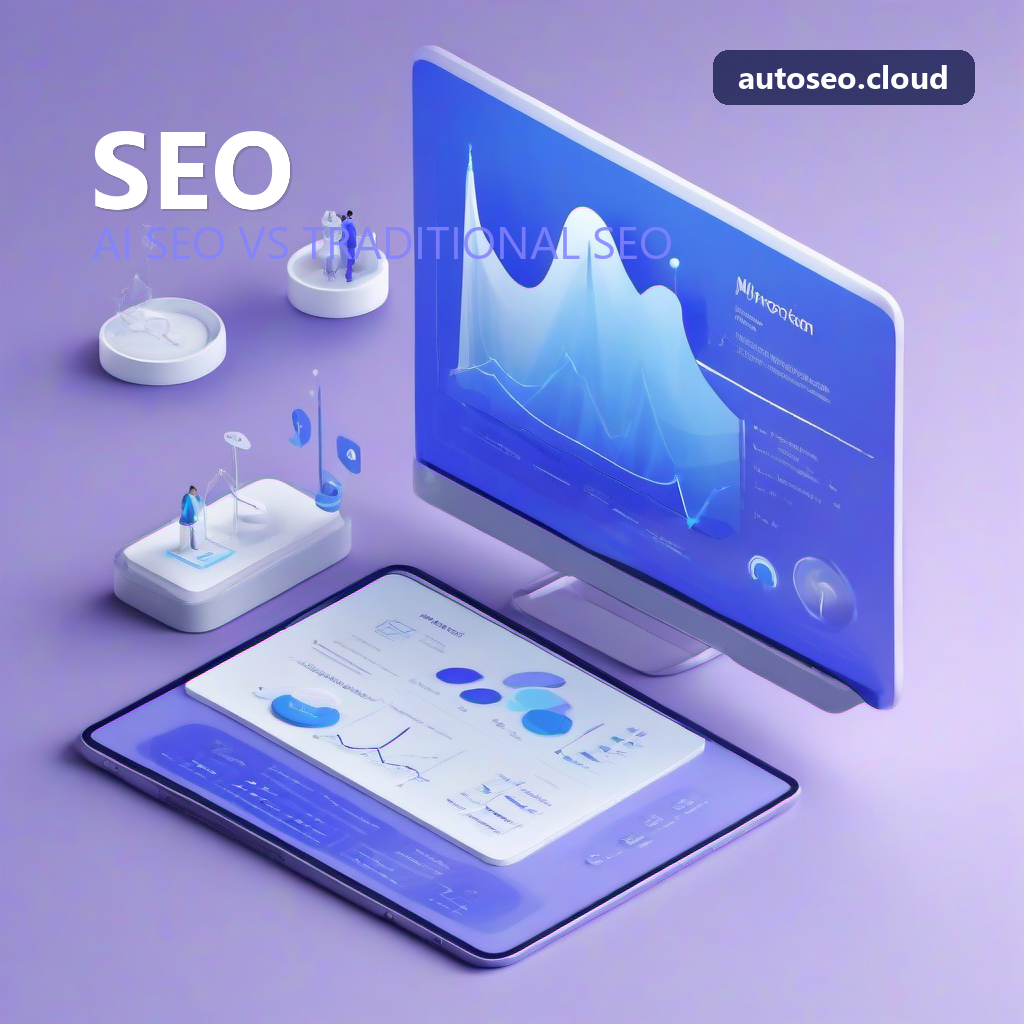
AutoSEO Impact: Verified traffic growth.